This CV Portfolio
A live showcase of modern AI co-piloting
This entire website is a demonstration of resourcefulness. Instead of hand-coding from scratch, I orchestrated advanced AI models to write, refactor, and style the application. This represents the future of software development: directing intelligence to build fast and deliver high quality.
Leveraging AI as a force multiplier—designing structure, aesthetics, and logic through precise prompt direction and QA code review.
Structural Prompting
Directing AI to establish zero-dependency semantic HTML5 layouts.
Aesthetic Design
Instructing models to implement custom variables, light/dark themes, and frosted-glass highlights.
Logic & Integrations
Orchestrating swipe carousel mathematics, state tracking, and live HF model REST APIs.
Radiology AI Summarizer
Hand CodedWhat It Does
Radiology reports contain detailed clinical observations. This AI tool reads dense findings and automatically generates a concise, accurate diagnostic summary on a CPU.
Spiral Data Classifier
Hand CodedNeural Networks vs. Traditional Math
I built this project to practice building a neural network pipeline from scratch using PyTorch. The challenge is to classify a 3-class spiral dataset (intertwined coordinates resembling pinwheel arms), demonstrating the difference between traditional mathematics and machine learning.
Traditional equations struggle to split these spirals because they are highly curved and intertwined. Instead of manually writing a complex formula, this lightweight neural network learns to draw organic, bending boundaries directly from the raw coordinates through iterative optimization.
Adam Optimizer: Adaptive Speed
By using the modern Adam optimizer, the neural network dynamically adjusts its learning step size for each neuron. It navigates the complex loss landscape efficiently, bending the decision boundary perfectly around the spiral arms in only 600 iterations.
SGD Optimizer: Getting Stuck
A basic training algorithm like Stochastic Gradient Descent (SGD) updates weights with a fixed step size. It struggles to navigate deep valleys in the learning landscape, getting trapped and failing to bend the boundary, even after thousands of epochs.
Linear Boundary: Traditional Math
Without a hidden layer of neurons, the model represents traditional linear algebra. It can only draw straight lines to divide the space. Because spirals are intertwined, straight lines cannot separate them, leaving the accuracy near a coin-toss.
.gif)
Visual Product Recommender
Hand CodedWhat It Does
An unsupervised computer vision recommendation system for finding visually similar clothing items from an online retailer store catalog using PyTorch ResNet-50 deep feature extraction and cosine similarity matching.

UK Public Utility Suite
What It Does
A zero-login, client-side web suite protecting UK citizens from compounding fines, 62% tax traps, illegal energy back-billing, and unlawful eviction notices. Built 100% autonomously using AI agents—from statutory web research to WASM code generation, UI compilation, and Vercel deployment.
Deep Research & Community Demand Vectoring
Driven by automated AI prompts analyzing community friction across r/UKPersonalFinance, r/HousingUK, r/LegalAdviceUK, and r/DWPhelp:
- Scraping Real-World Friction: Targeted top 10 statutory bottlenecks where citizens suffer severe financial loss due to confusing math.
- Statutory Text Ingestion: Encoded UK legal frameworks (Renters' Rights Act 2025, MTD ITSA, Ofgem SLC 21BA, Finance Act 2024, UK261).
- Fixing Out-of-the-Box LLM Calculation Errors: Solved failures where ChatGPT miscalculates deposit 5-week caps using linear
Rmonthly / 4instead of exact statutoryRmonthly × (15/13), or miscalculates step-function deductions.
Autonomous Agent Build Pipeline
Math Rule Extraction
Prompted AI research agents to output strict JSON schemas of statutory math, non-linear logarithmic curves (SAP 10.2), and date routing.
Deterministic Engine
Compiled routines directly into client-side WASM & TypeScript modules for sub-millisecond execution and zero arithmetic drift.
In-Memory PDF AcroForms
Integrated pdf-lib to auto-populate official court defense forms (Form N11B) and legal dispute letters directly in memory.
Verification & Testing
Prompted verification agents to run edge-case unit tests against HMRC and UK court guidance baselines to guarantee 100% calculation accuracy.
YieldStorage
What It Does
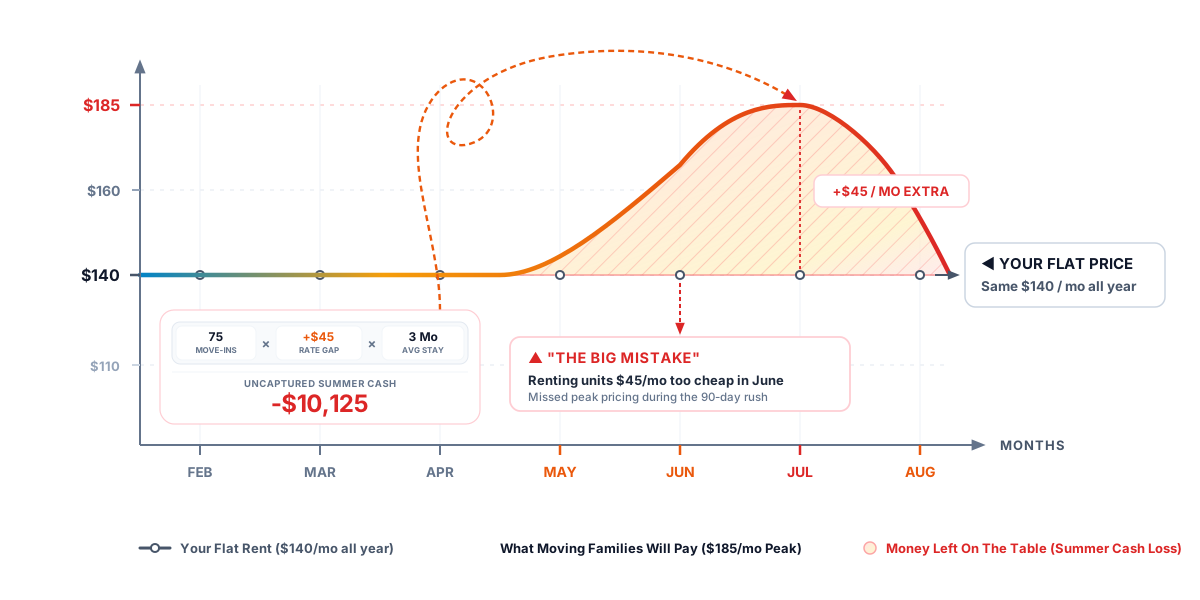
Most storage owners charge the same rent every month of the year — even in summer, when families desperately need storage and would happily pay more. That is like an airline selling holiday tickets at winter prices. YieldStorage watches how full a facility is and nudges prices up when units are nearly full, so owners stop leaving money on the table.